|
|

This was the summer of Robert Sheckley. The great writer came to Italy, thanks to the initiative and dedication of Roberto Quaglia, who invited him, looked after him and chauffeured him around Italy and Europe for a whole month. Anyone who had the chance to see him came away thrilled — see in this issue the comments by Vittorio Curtoni in Memories of green
and by Roberto Genovesi in Interazioni — and we have decided to offer you this chronicle of the experience, a little peculiar (it could hardly be otherwise, being penned by Quaglia) and extremely fascinating (ditto).
Arrival in Italy
Milan Linate, Wednesday 21 July 1999, 2:30 p.m.
Planes come and go in great number, but only one is the important one. Three of us went to the airport: Max Morando,
Daniele Vecchi and the undersigned. At a bit past three the only important plane of that day was supposed to place into our hands the only Robert Sheckley
in the universe known to us. It is hard to believe, even though a long sequence of improbable events had made this possibility blessedly probable. Years and years of email correspondence, earlier attempts aborted by Chance, and at last an admirable geometry of favourable coincidences. And so the improbable becomes inevitable, and there we are at Linate, quivering with our finest emotion. The plane we are waiting for lands. We prepare for the encounter, and shortly after we see the passengers file past us. Which of them will be Sheckley? We don't really know what he looks like. In our memory, only the recollection of a few photos decades old. Will that be enough to recognise him? We carefully study every face that passes before us. And in doing so we slowly fall victim to that very Metaphorical Deformation that Sheckley invented in one of his books. We begin to hallucinate Sheckley in every unaccompanied individual of a certain age. We even end up following some of them, trying to get ourselves noticed, hoping they will turn into the Sheckley they evidently are not. Time passes, and by now almost all the passengers have passed in vain through our sieve. The Metaphorical Deformation presses on, and even an old Japanese man seems for a few moments as if he might be Ours. Then the passengers run out, and so does Daniele's time, as he has to get back to the office. Max and I remain, and the only thing we can do is wait for the next plane.
The important plane turns out to be the 6:30 p.m. one. And finally, all at once, Sheckley is with us. He is wearing Bermuda shorts and flip-flops, and carries with him only a large bag, a small rucksack, and an elegant jacket he holds in his hand. For the whole journey, over the following month, he will not put it on even once.
Two hours later we are in Genoa, where Sheckley is the guest of Maurizio
Frizziero (Popi to his friends), in his lovely house facing the little beach of Boccadasse, perhaps the most evocative corner of Genoa of all. There, before a table laid with ham and melon, we spend a splendid evening in conversation, above all about the improbability of what is happening to us. Popi and I realise at once that Sheckley is not here, nor could he ever be. With us here is only Robert, and Robert is real and exists in flesh and blood and is here with us, whereas Sheckley exists in our brains as a representation. Representation of the representation, Mario will later quibble. In any case a myth, an archetype, an abstract entity that our senses will never be able to know, so much have we imagined it in the past. For convenience I shall nevertheless call him Sheckley in the remainder of this account of mine. But know that in reality I shall be thinking of Robert, because he is the one I came to know.
Thursday 22 July is a day of acclimatisation. It is very hot, there is a jet lag to overcome, we decide not to wear ourselves out. Which does not stop us from enjoying a splendid evening at the establishment of Enrico Reboscio, restaurateur and admirer of Sheckley, who offers us a wide sweep of typical Ligurian gastronomic specialities.
 |
 |
|
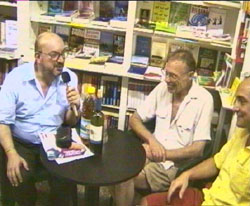
| At the Fahrenheit 451 bookshop |
|
Friday 23 July we are in Piacenza. We have been invited to lunch by Vittorio
Curtoni, a delightful person, quite beyond his merits in the field of Italian science fiction. And the lunch, cooked by his wife Lucia, is decidedly equal to the occasion. After eating, Sheckley allows himself a little nap on the sofa. Later, Vittorio will declare that he would have a plaque mounted above the sofa engraved:
Here slept Robert Sheckley. Which will later lead us to the idea, for a future trip, of preparing a plaque reading
Robert Sheckley is here right now, to be displayed in real time wherever we stop. In the afternoon reality intensifies. Admirers of Sheckley arrive at Curtoni's house on pilgrimage from half of Italy. Then we head to the Fahrenheit 451 bookshop, where Our Man is interviewed for a local television station. Then everyone ends up eating in an excellent trattoria. The Witnesses of Sheckley have grown more numerous still, and now there are forty people eating with him. After dinner we go back to the bookshop for a public presentation of the author. At eleven in the evening we set off home again, towards Genoa. It has been a wonderful day, described more fully and from another point of view by Vittorio Curtoni in this very issue of Delos. Sheckley is very happy. So am I. So is Vittorio. If there is any malcontent, he has evidently slipped discreetly aside.
Saturday 24 July and Sunday 25 July are relatively quiet days. But no less significant for that. Great Things are not necessarily big things. We knock about Genoa and its surroundings a little with Alessandro Testa and other friends, but we are all the sort more interested in the things we say to one another than in the things we do. On Sunday, at Popi's house, with the blue sea that from the window discreetly reminds us of the existence of the world, we also watch the motor-racing Grand Prix on television absent-mindedly, aware that one backdrop is as good as another for our conversations.
Monday 26 July we take a little trip along the riviera, to Camogli, and by boat we even manage a hop over to San Fruttuoso di Camogli. The weather is always fine. And so are our chats. I shall be able to show you photographs that convince you the weather is fine. But as for the conversations, you will have to take my word for it. We are always happy.
Tuesday 27 July the Cinque Terre fall to our lot. Sheckley had heard good things about them, so we decide to visit. We drive as far as Manarola. On foot, walking the notorious Via dell'Amore under a scorching sun, we reach Riomaggiore. From here a boat takes us to Vernazza, from where a train brings us back to our car in Manarola. To say it takes but a handful of words; to do it takes a fair amount of time and considerable effort. Lovers of excess, on the way back we find time and energy for a visit to Portofino as well. When the day ends, Sheckley is exhausted. But the Cinque Terre have left him speechless, and not only on account of the tiredness.
We decide that Wednesday 28 July should be a day of complete rest. It rains, and with the rain the temperature drops, granting us a respite and favouring a better rest. The day is nonetheless enlivened by a visit from Natalino Bruzzone, who at Popi's house conducts a splendid interview for the cultural page of the Secolo XIX.
|
 |
|
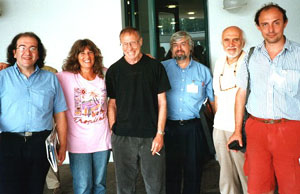
| At Mondadori: from left Lippi, Laura Serra, Sheckley, Festino, Alessandri, Quaglia |
|
Thursday 29 July we go to Milan. First stop: Segrate, Mondadori. We are received by a most cordial Giuseppe Lippi, editor of Urania, and to our surprise we discover he is not alone: we find again Vittorio Curtoni, Laura Serra, Giuseppe Festino,
Piergiorgio Nicolazzini, Ferruccio Alessandri, all already present in Piacenza, plus Claudio Asciuti,
Domenico Gallo and various others. We lunch in Mondadori's canteen, after which Sheckley is whisked away from us for a round of interviews and business discussions. We wait patiently for a long time in a bare little room. One by one they all leave, and I find myself waiting more or less alone. At last the vanished ones reappear, and we can head into town. Destination: the Libreria del Giallo, at Via Peschiera 1. An excellent place, so much so that I even give its address. Other fans converge there and at once there is a lively chatter, washed down with the sparkling wine the owners offer. There appears too Claudio
del Maso. And at once it is evening, that is, dinner time, or rather: pizza time. For the occasion there appears too Luca
Masali. A great collective pizza feast seasoned with four further chats. We are all happy, and whoever isn't, seems it. A couple of hours' drive to return to Boccadasse, and this long day too draws to a close.
Friday 30 July we leave Genoa and Boccadasse. Sheckley asks me: Won't we come back here again? I answer: Not on this trip. I shall long remember the immediate sadness that took hold of his face. As we say goodbye to him, Popi looks at him, smiles and says: There is no need for us to say anything now. Sheckley barely nods and comes away with me. Popi and Robert had already said much to each other in the long nights spent talking while others slept. We get into the car and set off for Lucca, where we arrive some hours later. We are welcomed by Alessandro Fambrini, who comes to fetch us on his bicycle and leads the way to his house, where we shall be guests. It is a quiet afternoon that awaits us. We are not dying to do what tourists do when they arrive somewhere. One rests a little, takes a leisurely drive around the city walls, goes to the station to pick up Stefano Carducci arriving from Treviso. And in the evening we all go to eat at an excellent trattoria on the hill.
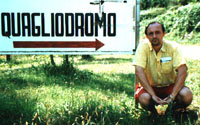
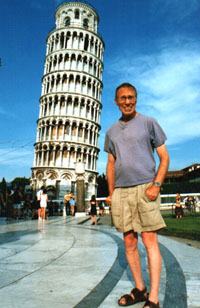
Saturday 31 July begins with a wander over the surrounding hills, where we come upon an improbable quail-drome, a sinister place in any case from which I instinctively want to keep my distance. We decide to change air and move to Pisa, where we are taken in charge by Francesco Ghetti, who acts as our tour guide. In the evening, we are his guests for dinner, and the quantity and quality of the courses is such as to put us decidedly into crisis (above all the undersigned). In plain words: eaten and drunk too much. But how was one to resist? One way or another we find our way home again and face a long night of sleep and digestion.
Sunday 1 August is a day little recommended for taking to the motorway. But the logic of the intelligent departures helps us. Ever since the intelligent departurescame into fashion, the traditionally worst days for setting out have become the best, since no one is so stupid as to set off on a journey on those very days. So we meet no traffic on the motorways and reach Treviso without trouble in the early afternoon. We lodge at the house of Stefano Carducci. We rest a few hours, and in the evening we roam about the city, stopping to dine at yet another excellent trattoria, where our noble intentions of dietary fasting founder for the umpteenth time.
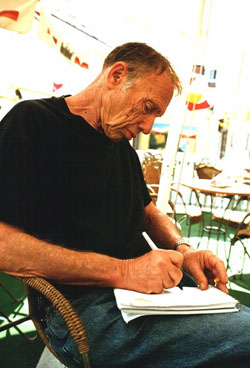
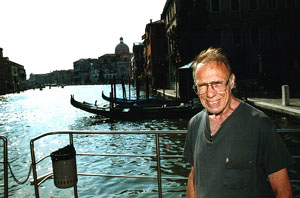
Monday 2 August we go to Venice. It is very hot, there is much sun and even more tourists. Sheckley had not seen Venice for some twenty years. The place inspires him and so he sets to writing. Everywhere, throughout our entire pilgrimage, Sheckley will not abandon his notebook and his beloved Montblanc pen even for a moment. Every day, many times a day, we have seen and shall see him whip out notebook and pen and begin or continue writing. But in Venice it is a special moment. We see him write with more intense dedication than usual. After a mediocre pizza we visit the bookshop of Giampaolo
Cossato. In mid-afternoon it is time to return to Treviso for a bit of siesta. We have discovered that the details of Venice, as indeed of all places, do not interest Sheckley all that much. What he seeks in the places he visits is the atmosphere they convey. Atmosphere is the ineffable component of places, the most interesting aspect of what surrounds you. In the evening, Daniele Vecchi joins us with his wife Debora, and all together we dine very well at the Carducci home. Stefano produces a repertoire of vinyl records with music Sheckley had not heard in decades. And at once there is nostalgia, or something from that family of emotions. The evening unfolds and concludes pleasantly.
Prague
Tuesday 3 August early in the morning Mario Quaglia, Ada Cortese and Max Morando arrive from Genoa. It is with them that we take to the road and leave Italy, the car's snout pointed north. There are five of us in my car, we are cramped (above all those in the back seats, since Max alone contains some 120 kilos of himself), but the boot is large and the engine does its duty. We exit at Tarvisio and head towards Salzburg, then turn right towards Linz, after which we take the trunk road north and plunge into the Czech Republic. We reach Prague around nine in the evening after a day of travel, sunshine and most pleasant landscapes. We are awaited by Yaroslav Olsa
Jr., a young Czech diplomat and one of the foremost science-fiction experts in his country. It is he who invited us to Prague, and it is he who puts at our disposal a comfortable flat where we take up lodging. There is still time and energy for a little dinner in the nearest trattoria. I don't know about the others, but I am wrecked. I have driven all day and a night of deep sleep is decidedly welcome.
|
 |
|
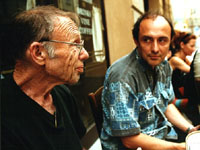
| Sheckley and Quaglia at a café in Prague |
|
Wednesday 4 August What does one do on one's first day in Prague? One has a look around. One goes into the maze of the old centre to look at the souvenirs they sell in every tourist spot in the world, one tries to glimpse a little of Prague through the thick blanket of tourists, and that is in fact what we do. For a few hours. Here and there one sits down to drink a coffee or nibble something. We are further north and at last the temperature is bearable. And the weather is fine anyway. And despite the tourists Prague has a unique atmosphere. In the afternoon we spend 20,000 lire on a taxi to cover eight hundred metres to the Ministry of Foreign Affairs, where Yaroslav Olsa awaits us. Impeccably buttoned up in his elegant diplomat's suit, Yaroslav receives us in the company of a fascinating colleague of his of rare intelligence, Jana
Pechova, who will stay with us for the rest of the day. The Ministry of Foreign Affairs is on a hill, and a slow walk down to the valley weds the touristic requirements perfectly with our legitimate laziness. Also because at the foot of the hill we find ourselves in Yaroslav's exotic house, brimming with African artworks as well as, above all, science-fiction books from all over the world. But I am not talking about the world you know. I am talking about Burmese, Ethiopian, Congolese science-fiction books, and so on and so forth. One gem after another. And we drink to it. It is aperitif hour. Shortly, the gotha of Czech science fiction will be awaiting us in one of the most exclusive little restaurants of the centre. And there we are indeed, shortly after, in that refined setting whose location, alas, I have forgotten, seated at a large table lit only by candles awaiting a dinner based on Bohemian cuisine. Besides Us, Yaroslav and Jana, there are Ondrej Neff, a well-known Czech writer, Ivo Zelezny, an SF publisher, Ivan Adamovic, editor of the magazine Ikarie and various others. The food is good, but in time I would have forgotten it, since the context is more interesting. We also drink a great deal of good wine. At the end of dinner we all go to a famous beer hall where now and then, it seems, President Havel himself would show up. We pass within a step of the Jewish ghetto, where at that very instant they are filming a scene of a film set some time ago. We see a great many Nazis, busy rounding up Jews. Shortly after we are in the beer hall, where I resolve to drink nothing. It would be too much. My resolve, however, does not hold a handful of seconds. And down with the beer, really good! We are all happy. Very happy. It is a trip full of happinesses. This is not an everyday thing. It is a pity that every time one is happy one then has, in the end, to go to sleep all the same. And the next day one has to start over from the beginning.
Thursday 5 August We start over from the beginning by promptly letting a video camera be stolen from us. Not the best thing for restoring the previous day's happiness. We loiter about the centre of Prague awaiting the next appointment. In the afternoon the fans await us in one of the principal science-fiction clubs. There the welcome is very warm, but only for Sheckley. For some hours no one notices that alongside Sheckley there are three other people, and no one deigns to greet us. Subjectively, I preferred the previous evening's VIPs. After a while we Italians indeed begin to feel superfluous. What are we doing there? After a while someone I know turns up and the situation improves a little. Yaroslav had warned me, cautioning me about the Czechs' scant sociability. Then again, you have to try it to believe it. The only emotion is to observe the mystical trance of a likeable Russian fan in the presence of Sheckley. Rarely have I seen so much emotion in the eyes of a stranger. And a little emotional osmosis is the logical consequence. Of this afternoon I shall thus in future remember only the eyes of this lad. Also because, while I was at it, I filmed the whole scene. In the evening we dine with a group of fans.
Hungary
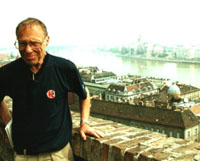
Friday 6 August On the road again. We set off for Budapest, in no hurry, in mid-morning. The journey turns out longer than necessary because of a useless detour through Austria. We reach Budapest towards evening, and quickly find somewhere to sleep. Since I have always been the one driving, I am considerably tired. This does not stop us from going to dine on a boat on the Danube, where — woe to us — we overdo it. The fault of food too good.
Saturday 7 August After breakfast, a nice tour of Budapest, just to get an idea. In the afternoon we set off again, heading southeast. We enjoy the last eighty kilometres of motorway. After that it will be only trunk roads. It is scorching hot, but the air conditioning saves us. We pass the last Hungarian city, Szeged, and at last reach the border with Romania. Everything is jammed, and it takes more than an hour to get through. Another hour we virtually lose because of the change of time zone. It is late afternoon when at last we hurtle across the desolate plains of the Romanian countryside in the northwest of the country. It does not take long to reach Timisoara, our destination for today. At the Continental hotel we find and appreciate the rooms that have been booked for us. Sheckley is tired and perplexed. He declares that Italy was another thing. But he does not complain, nor does he regret being there. It is already evening, and there is just time to eat something on the hotel's terrace-restaurant, while next to us dancers not excessively dressed put on a show for the live broadcast of a local TV. Before a good meal and a good beer, as well as a good few unbridled dancers a little further off, Sheckley's mood too quickly recovers. During the hours and hours spent in the car over the last days he has written a great deal, and that is enough to make him satisfied. Sitting and writing, he observes, is what he has always happened to do, and in the car with us he can moreover also chat and watch the changing landscape.
Romania
Sunday 8 August It is very hot in Timisoara. In the hotel lobby we meet those who invited us to Romania. Jonathan
Cowie, a Scottish scientist as well as a refined individual and most agreeable friend, gives us his warm welcome. He is, more than others, the organiser of the event we have come to take part in. But many have converged on the Continental to greet us. There is
Jim Walker, like Jonathan come from England. There are the Romanians Silviu Genescu, Antuza Genescu
e Dorin Davideanu. After the inevitable pleasantries of the occasion, we opt for a visit to the local museum of country houses, a park in which the traditional Romanian country houses have been reconstructed. It is not the end of the world, but it is at least something new, and in any case the occasion for a walk. There is a much larger and more interesting museum of the kind in Bucharest, but we are in Timisoara. Which on the whole is anyway an interesting and pleasant place. In the afternoon there is the opening ceremony of the convention. Personally I abhor any ceremony of any kind whatsoever, so I shall not pretend to convince you that it is for me a source of joy. Let us say I am bored less than usual. Probably, ceremonies of this sort are a necessary evil. In the evening, we typically dine the Romanian way. As cuisine it is not bad, but it is not very varied, and after a few meals one has already tried everything.
 |
|
|
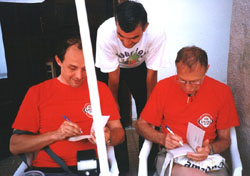
| Sheckley and Quaglia, sponsored, sign autographs |
|
Monday 9 August we are taken to see a museum. We are not museum types, neither Sheckley nor the undersigned, so before long we make our escape, and take refuge in a McDonald's, a place neither of us generally frequents. But here it is hellishly hot, and McDonald's has air conditioning. And besides it is not compulsory to eat. That is what the drinks are for. Shortly after, the crew of a national television channel comes to interview us. In the afternoon, a bit of respite at the hotel. The Continental hotel is large and welcoming, it counts some ten floors of which there is one interesting one: the second. Day by day we all in fact become sensitive to what we begin to call the Mystery of the Second Floor: each of us, in fact, in his up-and-down with the lift, frequently happens to find himself in the company of splendid maidens whom to call dressed is too much, all of whom invariably enter or exit the lift on the second floor. Said graces then vanish who knows where with the same suddenness with which they appear. Thorough explorations of the second floor do nothing to clear up the mystery. And all that remains to us are our hypotheses.
|
 |
|
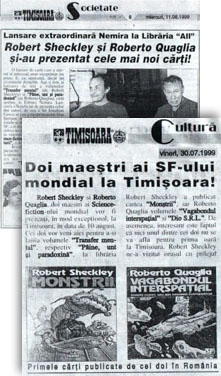
| The Timisoara newspapers the next day |
|
Tuesday 10 August I have not yet properly woken up when I find myself with Sheckley, Max, Mario, Ada, Jonathan and all the rest at the BIC-ALL bookshop for the presentation of the Romanian edition of Sheckley's book
Scambio Mentale (Transfer Mental) and of mine Pane, burro e paradossina
(Pâine, unt si paradoxina), both published by Nemira. There is also a sponsor in the mix, Kaiser beer, and Sheckley and I have to wear red T-shirts with the beer's brand, and above all we have to drink a lot of beer, the ideal thing fresh from waking. There is also the deputy mayor of Timisoara, who launches into a long speech in Romanian. When it is my turn I talk at random for a while, as I have been wont to do for ages now, well knowing that whatever I say everyone will forget it quickly anyway, except that this time I am mistaken. In the following days I shall in fact rediscover, with a certain horror, my disjointed arguments faithfully reported in several articles in all the local newspapers, as if they really meant something. Sheckley, more prudent, chooses a soberer line. There is relatively quite a lot of public, since in the preceding days the local newspapers have pumped up the event, illustrating the articles also with images downloaded, without my knowledge, from my sites on the Internet. Nemira's marketing director, Laurentiu
Teohar, has evidently worked well. After the speeches a traditional siege for the autograph on the copies of the books does not bother us at all, and at last this fine moment too fades. And the generic hours resume their flow in the torrid heat of Timisoara and we go back to taking refuge for a few minutes in McDonald's. At five in the afternoon we attend a lecture by Jonathan Cowie on tomorrow's eclipse.
Eclipse
 |
|
|
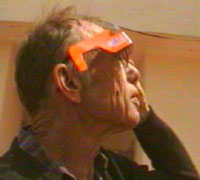
| Sheckley looks at the eclipse |
|
Wednesday 11 August is the day of the total solar eclipse. And it begins terribly. The sky is entirely overcast and it is raining. Then it stops, but the sky does not improve. At last it turns cold. Sheckley says that a bit of coolness is more welcome to him than the eclipse. Nevertheless I decide not to be put out anyway. It will in any case be interesting to see day turn into night. Meanwhile the partial eclipse begins, or so at least our little chart says. We can see nothing, apart from the normal things. Except that the clouds slowly thin out, and suddenly someone catches sight of a semblance of sun filtering through the spiteful sky. At once there is a great rush to fetch the eclipse glasses. The sky opens a little more and now and then the sun shows itself in full for a few minutes. And so we have had our partial eclipse, we tell ourselves. We approach the moment of totality, and the sky opens more and more. Perhaps we are lucky. The meteorological unknown makes the whole thing probably much more thrilling than it would have been in ideal weather conditions. We are in our hotel and climb up to the terrace. From there one commands the whole city. Every so often a brief shower of water comes down, just for good measure. On the roof, a local TV interviews Sheckley and me live and, on the pretext of the eclipse, we advertise our books. Only a handful of minutes now remain to the fateful moment, and the sky has turned promising again. A dash down to the room to follow on television the progress of the total eclipse across Europe. TV via satellite, British, French and German programmes, which in sequence document and comment on the total eclipse that comes and goes. Unexpectedly, it is moving, despite the idiocies the various commentators cannot help saying. When the total eclipse leaves Austria too, it is time to rush back up to the roof. There is a struggle for the lift, but we are the ones who win. The sun is still visible, through a thin layer of swiftly moving cloud, but there is only a tiny crescent of it. The clouds act as a filter and one can even look with the naked eye without problems. On the horizon, meanwhile, the sky has turned jet black to the west. It is the total eclipse advancing. Then an ugly cloud ends up where it should not, and the sun disappears, entirely eclipsed by the cloud an instant before it is by the moon. And then all at once everything is dark, and so it remains for a while. We see the unwelcome cloud move, but not fast enough. The city is in darkness, the sky above us is dark, but the horizon is most luminous through 360 degrees. A panorama never seen before. Then the line of light draws near, just as the darkness had come before. I look up and the cloud has almost gone — I hear a roar of voices coming from another part of the city. Over there the cloud has already gone, and for a moment the total eclipse has been seen. I look down: still dark. I look up again: and suddenly a blinding ray of sun strikes me, and for a moment I glimpse a piece of diamond ring, the image that marks the end of the total eclipse. I look down and the city is lit. We have missed the total eclipse by two or three seconds or, if you prefer, by two or three hundred metres. But we probably would not have had all the emotions we had if things had gone the way we would have wanted them to go. From that moment on, in any case, the mocking sun has not ceased to shine.
Thursday 12 August is our last day in Timisoara. In the afternoon Sheckley, Tony Chester and I are busy chatting at a round table. In the evening, a gala dinner in a restaurant reserved almost entirely for us. It seems a nice place, we settle in and for a while all goes well. But between the first course and the second two hours of waiting pass, honestly too many not to grow irritable. After dinner there are the ritual pleasantries that accompany the aftermath of all gala dinners, and Sheckley shrewdly withdraws to the hotel. We too shall follow him before long. Tomorrow will be a hard day.
 |
|
|
| Any moment is good for jotting down some notes |
|
Friday 13 August is a hard day. At half past eight in the morning we have loaded everything and everyone into the car and we set off, towards the southeast of the country. There are practically no motorways in Romania, and the trunk roads, though recently re-surfaced, are no joke, especially if one has to travel seven hundred kilometres along them in a row. Also because in crossing the country one is on the same route as all the commercial traffic of the nation, and not only: which means columns of Romanian, Bulgarian, Turkish, but also Italian and German lorries. All of it seasoned with threshing machines that now and then pop out from behind a bend taking up a lane and a half, thousands of peasants' carts drawn by horses, caravans of gypsies who likewise move with their carts and horses, flocks of sheep that now and then cross the road with indifference, solitary and non-solitary cows and suicidal stray dogs. At regular intervals, in fact, the edges of Romania's roads are studded with the carcasses of dogs that crossed the road at the wrong moment. There are millions of stray dogs in Romania, which increase incessantly, and from what was explained to me the European community has ordered the Romanians not to put them down so as not to violate their animal rights, or something of the sort. I don't know if it is true but it would be typical, and meanwhile the stray dogs increase, forming veritable packs that now and then, according to some, even gobble up the odd child. And meanwhile I drive. I have it for the whole day. Unlike driving on the motorway, here you cannot let yourself be distracted for a moment. Woe betide you if you take your eyes off the road! Years ago, when I came to these parts together with Silvio Sosio and Luigi Pachì, to try to soothe their shock at the Romanian roads (in those days they were far less asphalted than now) I told them that the roads in Romania are a metaphor for life: you never know what will come in a moment, and when you least expect it you run into some unforeseen thing. We enter the Carpathians and tackle the crossing of Transylvania in a lugubrious and fascinating climate. The weather is foul, the clouds are low and it begins to pour down. We rejoice at the fitting atmosphere, but the joy is short-lived. The road runs alongside a river and to our right there are only rock walls. From which, by virtue of the rain, it is not only water that comes down. More and more frequently we run into a landslide obstructing part of our carriageway. It is encouraging. Until the road is suddenly blocked by a landslide happening at that very moment right in front of us. The cars are all there, stopped, waiting. The road is not yet entirely blocked, but boulders and pebbles roll across the road making transit unappealing. Now and then some car tries its luck and gets through, attempting to dribble past the rocks already on the road and the others, more dangerous, on their way. I pull onto the overtaking lane and draw near. I stop. Do we try to get through or wait still? In a little while it could be too late, the road could obstruct completely. At that moment a great boulder hurtles at top speed across the road in front of us. It is Russian roulette. Luckily, the landslide in progress is now perfectly visible in its whole unfolding. All sorts of things are coming down the steep slope to our right, but it is clearly visible, and for the most part they are small pebbles. Which means that with a bit of care one can get through without too much risk, in tune with the timing of the landslide so as to avoid the rare boulders. I press the pedal on the accelerator, igniting the turbo of the engine and of the adrenaline. As I pass through the landslide a wheel flicks a stone against the underframe of the car and the loud noise of the impact does not cheer us. A moment later I am hurtling at an unheard-of speed between the cars that on the other side of the landslide stand waiting, and someone providentially points it out to me. When the adrenaline turbo kicks in, there is a chance that one forgets to switch it off. Not without effort I switch it off and slow down. I feel a little guilty towards Sheckley for having brought him all the way here and so I say to him: At least it is not a boring trip. Sheckley replies with a convinced air: No, it is not boring. Of us all he seems the least worried. He sets to writing again at once. I peek at his notebook and read We stopped at one point and watched a flow
of small pubbles trickle out of a hole in the mountainside and onto the
road. It was like the Earth was bleeding. For him events are above all the cue to have something to write. The Carpathians are almost about to end. It keeps pouring. Sheckley keeps writing. I steal another handful of phrases from him: The flooding grew worse as we continued.
A deserted car park had become a lake, empty except for one white plasticchair
floating in it. Occasionally we passed a peasant, standing at the side
of the road, huddled under a plastic raincoat, waiting for God knows what.
But for the most part we encountered no one. When we think we have got past the worst, we run into a jam. There is a dip in the road that has filled with water. The lorries pass through, but a car that tries to do likewise sinks and stays there. There is no getting through here. Luckily there is an alternative road, but we have to go back a few kilometres. I make a U-turn and, retracing in the opposite direction the road just travelled, I soon run into a great boulder in the middle of the road. A little earlier it was not there. It came down shortly after our first passage there and shortly before our second. We are lucky, or in any case we are not unlucky. Half an hour later we have got over the Carpathians unscathed and it is plain again, which truly does not displease us even if the atmosphere is not equally interesting. We reach Bucharest around eight in the evening, but this is not our destination for today. We weigh up nonetheless whether to stop or not, then unanimously we decide to carry on. Darkness falls, and only then do I remember why I never wanted to travel through Romania by night. The others discover it for the first time. In the dark, the dazzling lights of the column of lorries on the opposite lane blind you, which is not exactly the best in Romania, where the roads hold surprise upon surprise, where the horse-drawn carts have no rear lights and where the occasional pedestrians walk almost in the middle of the road, trusting perhaps that the cars will avoid them, or more probably not posing themselves the problem at all. It is the least entertaining part of the trip. We reach Cernavoda between ten and eleven in the evening. There is a nuclear power station there, but we cannot complain too much. We Italians (or rather, we Genoese) built it together with the Canadians. We are put up in the spacious and luxurious flats once built for the station's Western personnel. We are tired, but also quite happy. For fifteen hours we have kept to the carriageway, incessantly overtaking cars, lorries and carts, taking care not to crash head-on into the lorries that on the overtaking lane you find before you at every moment, and we have survived.
|
 |
|
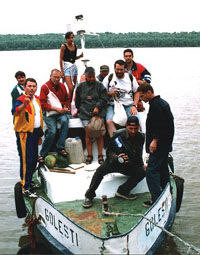
| On the boat to Atlantykron |
|
Saturday 14 August is a cloudy day. Thirty-five kilometres from Cernavoda there is a little island on the Danube called Atlantykron, near the village of Capidava. It is there that we go. A wild place out of the usual world where the Romanians annually organise a week of events relating to science fiction. A little boat ferries us over there. At least, I try to encourage Sheckley, no one here will take you on a sightseeing tour. Sheckley replies: That is good news. We are mistaken, however. Barely disembarked on the little island, Sorin
Repanovici, the organiser of the event, welcomes us and takes us on a sightseeing tour of the little island, showing us the tents and their occupants. Then one drinks and eats something on the deck of the boat moored to the island, after which a discussion-meeting with those present on the island follows. In the afternoon, Sheckley prefers to return to his little flat in Cernavoda because he wants to write a story and for this he needs solitude. By evening he will already have finished it and will be very happy about it.
Sunday 15 August we make our way back to Bucharest. It is the first step in the direction of home. In Bucharest we have at our disposal a couple of flats in which to stay. We go to lunch at Sydney, a very in Australian pub where they also serve Mexican stuff. And it is precisely there, seated at Sydney before a good exotic dish, that Sheckley states that Romania is beginning to appeal to him, and that he could imagine living there. In the afternoon, Sheckley wants to keep writing. I leave my laptop at his disposal and the rest of us go off to take a couple of turns. By evening he will have written another story.
 |
|
|
| On Romanian TV, interviewed by the minister |
|
Monday 16 August is a very intense day, begun with a fine earthquake. The tremor that destroyed Turkey made itself felt here too. Max and Ada, the only ones of us awake at that hour, testify that everything danced for a good while, as the chandeliers swung decidedly to and fro. I was asleep and noticed nothing. In the morning we are invited to Romanian television by Alexandru
Mironov, former minister of sport and youth as well as science-fiction expert and host of a science-fiction television programme on the first national channel, who produces an excellent programme centred on us. Sheckley is very happy, and I am no less so. It was a fine programme, with intelligent questions and discourse, far from every usual banality. For lunch we take refuge again at Sydney. And in the afternoon a second appearance on a television programme is in the offing. This time we are guests in the living room of
Mihaela Muraru Mandrea. In the evening, on the other hand, we are invited to dinner by Florin Munteanu, a most brilliant Romanian scientist and a very great friend of mine. It is a very fine evening, any description of which would be reductive. Sheckley is enthusiastic about it. What a fantastico man! he will comment later, thinking back on Florin.
Tuesday 17 August we go to Nemira, our publisher. We are well received by Valentin Nicolau, the publisher, and Vlad Popescu, his deputy. No perfunctory speeches. Instead, a good deal of time together chatting outside the usual rituals. There is also time for a hop into the editorial office of Anticipatia, the longest-lived Romanian SF magazine. Then the usual snack at Sydney. In the afternoon, Sheckley withdraws once more to write. We all go to bed early. Tomorrow will be a hard day.
Return
Wednesday 18 August we set off again for Italy. At half past five in the morning. Wake-up at half past four. It is the best system to spare ourselves some hours of heavy traffic and shorten the journey's duration. One travels indeed fast and without too many problems. By setting off so early, we anticipate the great traffic flows and by early afternoon we are already at the Arad border. In mid-afternoon we reach Budapest, where we mean to stop. Having quickly found lodging for Sheckley, we spend some hours settling the rest of us too. Budapest is packed to the rafters, but in the end we find something. It is the moment of the trip when I am most tired. Always and only I alone have driven, and the fatigue has gone on accumulating. To say I am wrecked is an understatement. We go back to dine on the boat where we had eaten on the way out, and which we had liked so much. A month has passed since Sheckley has been with us, and now he eats on average twice as much as when he arrived. This evening he eats more than four times as much. He will say shortly after: I shall long remember this dinner. So shall we.
Thursday 19 August is the day of the return to Italy. We cross Austria, where on the motorway we also pick up a fine speeding fine, and towards evening we reach the airport of Venice, where suddenly Sheckley's return ticket can no longer be found. It is a little hour of suspense, then the ticket turns up. We find a nearby inn and so we also solve the problem of this last night. To celebrate the return to Italy we wolf down a couple of excellent pizzas each.
Friday 20 August Sheckley takes the plane that, via London and Seattle, will bring him back to Portland, Oregon, where his wife Gail awaits him. On the way back to Genoa there is silence in the car for a while. And it is Max who at a certain point says: He is no longer here. Mario retorts: He never was here. It is my turn: He was here, he was here, it was not a hallucination. And if it was, it is in any case a better hallucination than the others.
In reality perhaps I did not say it quite like that. But who cares about the details, now that Sheckley is no longer in this story?
Outside Time there is still time for a final consideration: what you have read so far is the mere chronology of what happened. Nothing truly significant is enclosed in what is written here. What truly matters cannot be told like this. Probably, it cannot be told at all. It can only be remembered, by the one who has lived it. And perhaps not even this is true. What truly matters can only be lived while one lives it. All the rest are only diaphanous representations. Or, if you prefer, representations of representations. That is, something which in the end has very little to do with reality. Let us be content, and you be content. The important thing is to misunderstand as little as possible.
A more complete photo album of the trip is available by clicking here. (http://www.fantascienza.com/quaglia/sheckley/1999/)
|




 Italiano
 Deutsch
 English
 Espanol
 Francais
 Latina
 Portugues
 Romana
 Russkij
 Zhongwen
 Nihongo
 Turkce
 Arabe
Arabe Farsi
Farsi